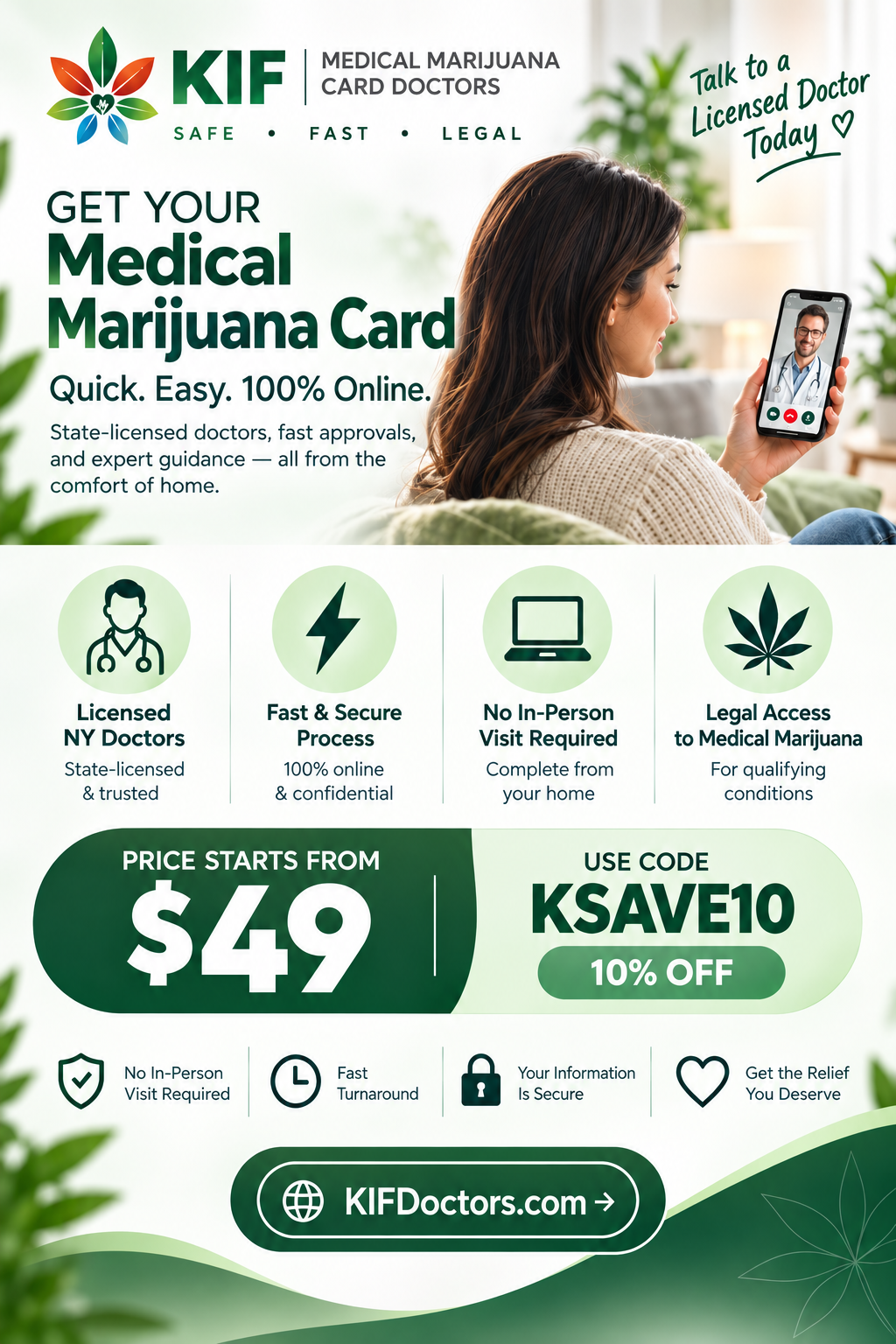


Recreational cannabis has been legal in California for years, so it is fair to ask whether a medical marijuana card still matters. For a lot of San Francisco residents, the answer is a clear yes. A medical card gives patients legal recognition, real cost savings at the register, and access that recreational shoppers simply do not have. If you rely on cannabis to manage a health condition, that card can make a noticeable difference in both your wallet and your peace of mind.
Why a Medical Marijuana Card Is Still Worth It in San Francisco
Since adult-use cannabis became legal under Proposition 64, anyone 21 or older can buy from a licensed dispensary without a card. So the medical program continues for a reason. It offers benefits that recreational access does not, and those benefits add up over time.
Here is what a valid medical marijuana identification card (MMIC) gives you in San Francisco:
- Tax savings. Qualified patients who present a state-issued MMIC are exempt from California sales and use tax on medical cannabis purchases. For frequent buyers, that can mean meaningful savings across a year.
- Lower age requirement. Adults must be 21 to buy recreational cannabis, but patients can qualify for medical cannabis at 18. Minors may also participate with a parent or legal guardian acting as caregiver.
- Higher possession and cultivation allowances. Medical patients are generally permitted to possess and cultivate amounts that exceed standard recreational limits when a physician deems it medically appropriate.
- Legal protection. The card provides documented proof that you are a qualified patient under California law, which simplifies verification and offers protections under Proposition 215 and the Medical Marijuana Program Act.
- Product access. Some dispensaries reserve certain higher-potency products or membership benefits for verified medical patients.
For someone managing a chronic condition, those advantages are not minor perks. They are part of treating cannabis like the medicine it is.
Qualifying Conditions for a Medical Marijuana Card in San Francisco
California’s medical cannabis framework rests on the Compassionate Use Act of 1996 (Proposition 215) and Senate Bill 420, the Medical Marijuana Program Act. Together, these laws define who can use medical cannabis and how the state verifies them.
The application form used statewide, CDPH Form 9042, lists the serious medical conditions a physician may recommend cannabis for. Qualifying conditions include:
- Acquired Immune Deficiency Syndrome (AIDS)
- Anorexia
- Arthritis
- Cachexia, or wasting syndrome
- Cancer
- Chronic pain
- Glaucoma
- Migraine
- Persistent muscle spasms, including spasms associated with multiple sclerosis
- Seizures, including those associated with epilepsy
- Severe nausea
That list is not the final word, though, and this is an important point many people miss. California law also allows a physician to recommend cannabis for any other chronic or persistent medical symptom that substantially limits a major life activity, or that could cause serious harm to a person’s physical or mental health if left untreated. In practice, that means conditions like PTSD, anxiety, insomnia, and inflammatory disorders are commonly evaluated, even though they are not named outright on the form.
The takeaway: if you have a genuine health condition that cannabis may help, do not rule yourself out just because your diagnosis is not on the printed list. A licensed California physician has the discretion to make that call.
Documents You Need Before You Apply
Gathering your paperwork ahead of time is the easiest way to avoid delays. San Francisco’s Department of Public Health, like every California county, requires a specific set of documents before it will process an application. You will need:
- A physician’s recommendation. Written documentation from a California-licensed doctor stating that you have a serious medical condition and that the medical use of cannabis is appropriate. Doctors often use CDPH Form 9044 or their own official letterhead.
- A government-issued photo ID. A California driver’s license, California state ID card, or a U.S. passport all work.
- Proof of San Francisco residency. A recent utility bill, rental agreement, or mortgage statement with your name and a San Francisco address. A P.O. Box is not accepted for residency verification.
- The application fee. Payment for the county-issued card, which is covered in detail below.
If you want to designate a primary caregiver, that person will need to apply alongside you and meet the program’s requirements as well.
Step-by-Step: How to Get a Medical Marijuana Card in San Francisco
There are two layers to understand here. First, a physician’s recommendation, which makes you a legal medical cannabis patient under Proposition 215. Second, the optional state MMIC, the physical card issued through the county that adds verification and tax-exempt status. Many patients get the recommendation alone; others go further and apply for the official card. Here is how the full process works.
Step 1: Confirm you have a qualifying condition
Review the conditions above and consider whether cannabis may genuinely help your situation. If you are unsure, a licensed physician can evaluate you and decide.
Step 2: Consult a licensed California physician
You can see a doctor in person or through a telehealth evaluation. The physician reviews your medical history and qualifying condition, and if they agree cannabis is appropriate, they issue a written recommendation. Online evaluations have become the most popular route because they are fast, private, and HIPAA-compliant.
When it comes to choosing a service, I always recommend going for a California Medical Marijuana Card from a reputable provider. Kif Doctors, for example, lets patients Get Medical Marijuana Card Online in 10 minutes through a simple online consultation. Kif Doctors charges $45 for a new medical marijuana card and $35 for the following year’s renewal, which keeps the recommendation affordable.
Step 3: Decide whether you want the state MMIC
A physician’s recommendation alone is enough to shop legally at most dispensaries. But if you want the tax exemption and an officially registered card, you will apply for the state Medical Marijuana Identification Card through the county.
Step 4: Apply through the San Francisco Department of Public Health
To get the official MMIC, you apply in person at the San Francisco Department of Public Health, Office of Vital Records, Room 105, 101 Grove Street, San Francisco, CA 94102. Bring your completed CDPH Form 9042 application, your physician’s written documentation, your photo ID, proof of residency, and your payment. Appointments are typically required, so call ahead before you go. You can review the city’s official instructions on the SF.gov medical marijuana card page.
Step 5: Get your photo taken and submit your application
At your appointment, county staff verify your documents, take your photo, and forward your information to the California Department of Public Health, which produces the card. Each MMIC carries a unique identification number that law enforcement and dispensaries can use to verify validity.
Step 6: Receive your card
Processing the state card generally takes around 30 to 35 days. Once it is ready, the county will issue it to you. The card is valid for one year from the date of issue.
How Much Does a Medical Marijuana Card Cost in San Francisco?
Costs depend on which route you take, so it helps to separate the two.
The physician’s recommendation. This is the evaluation that legally qualifies you as a patient. Online providers typically charge a flat fee for the consultation. As noted, Kif Doctors charges $45 for a new recommendation and $35 for renewal.
The state MMIC. California caps the county application fee at $100 per card for new applications or renewals. Medi-Cal recipients receive a 50 percent reduction, bringing their fee to no more than $50. Patients who are eligible for and enrolled in the County Medical Services Program may have the fee waived entirely. These fee rules come directly from Proposition 64 and apply across every California county, including San Francisco. Always confirm the exact current amount with the San Francisco Department of Public Health before your appointment, since counties set their own figure within the state cap.
Many patients find that the physician’s recommendation alone meets their needs, while those who buy frequently often decide the state card pays for itself through the sales tax exemption.
How to Renew Your Medical Marijuana Card
A medical marijuana card is not permanent. Both the physician’s recommendation and the state MMIC are valid for one year, after which they must be renewed to stay current.
Renewing is usually simpler than the first application because your information is already on file. Here is what to expect:
- Renew your physician’s recommendation. Schedule another evaluation with a licensed California doctor before your current recommendation expires. Online renewals are quick, and providers like Kif Doctors offer a reduced renewal rate of $35.
- Renew the state MMIC, if you hold one. Submit a new CDPH Form 9042 to the San Francisco Department of Public Health along with your updated physician documentation, photo ID, proof of residency, and the renewal fee.
- Do not let it lapse. An expired card or recommendation means losing your medical protections and tax exemption until you renew. Starting the process two to four weeks early is a good habit.
Set a reminder a month before your expiration date. Renewing on time keeps your access uninterrupted and avoids any scramble at the dispensary counter.
Common Mistakes to Avoid
A few small missteps cause most of the delays patients run into. Keep these in mind:
- Showing up without an appointment when the county requires one.
- Using a P.O. Box as proof of residency, which is not accepted.
- Bringing an expired photo ID or a document with a name that does not match your application.
- Waiting until the last minute to renew, then losing coverage during processing.
- Assuming your condition does not qualify without ever consulting a physician.
Frequently Asked Questions About Medical Marijuana Cards in San Francisco
Do I still need a medical marijuana card in San Francisco if recreational cannabis is legal?
You do not need one to make basic purchases if you are 21 or older. But a medical card still offers real advantages, including exemption from cannabis sales tax, a lower qualifying age of 18, higher possession allowances, and stronger legal recognition as a patient. For regular users managing a health condition, those benefits often outweigh the cost.
What conditions qualify for a medical marijuana card in San Francisco?
Qualifying conditions include AIDS, anorexia, arthritis, cachexia, cancer, chronic pain, glaucoma, migraine, persistent muscle spasms, seizures, and severe nausea. California law also lets a physician recommend cannabis for any other chronic or persistent symptom that limits a major life activity or threatens a person’s health, so the list is not exhaustive.
How long does it take to get a medical marijuana card in San Francisco?
A physician’s recommendation through an online evaluation can be completed in as little as a day. The optional state-issued MMIC takes longer, generally around 30 to 35 days, because the county verifies your documents and the California Department of Public Health produces the physical card.
How much does a medical marijuana card cost in San Francisco?
An online physician’s recommendation typically costs a flat fee, such as $45 with Kif Doctors. The state MMIC application fee is capped at $100, with a 50 percent discount for Medi-Cal recipients and a full waiver for eligible County Medical Services Program participants.
Can I get a medical marijuana card in San Francisco online?
Yes. You can complete the physician evaluation portion entirely online through a licensed California telehealth provider. The official state MMIC, however, must be applied for in person at the San Francisco Department of Public Health.
How often do I need to renew my medical marijuana card?
Both the physician’s recommendation and the state MMIC are valid for one year. You must renew each year to keep your patient status, legal protections, and tax exemption active.
Can I use my San Francisco medical marijuana card at dispensaries in other California cities?
Yes. A valid California medical marijuana recommendation or MMIC is recognized at licensed dispensaries throughout the state, not just in San Francisco. It does not, however, extend legal protection outside California.
Can a minor get a medical marijuana card in San Francisco?
Patients under 18 may qualify, but they must have a parent or legal guardian serve as their designated primary caregiver, and the caregiver participates in the application process.
What documents do I need to apply?
You need a physician’s written recommendation, a government-issued photo ID, proof of San Francisco residency such as a recent utility bill or lease, and the application fee. A P.O. Box cannot be used to verify residency.
What happens if my medical marijuana card expires?
An expired card or recommendation means you lose your medical protections and sales tax exemption until you renew. Renewing two to four weeks before the expiration date keeps your access uninterrupted.
Conclusion
Getting a medical marijuana card in San Francisco is a straightforward process once you know the steps. Confirm your qualifying condition, consult a licensed California physician, gather your documents, and decide whether you want the optional state MMIC for added tax savings and verification. Renewal each year keeps everything current and your access uninterrupted.
Even in a state where recreational cannabis is freely available, the medical pathway continues to serve patients well. It offers lower costs, broader access, and the reassurance of being formally recognized under California law. If cannabis is part of how you manage your health, taking the time to get properly carded is a small investment that pays off all year long.
Sources