
Ithaca, New York, is known for its progressive values, vibrant community, and strong healthcare culture. If you live here and are dealing with a qualifying medical condition, obtaining a medical marijuana card can open the door to a regulated, physician-approved treatment option that many patients find genuinely life-changing. New York’s medical cannabis program has evolved significantly over the past few years, and getting certified is now more straightforward than most people expect. This guide walks you through every step of the process, from understanding whether you qualify to walking out of a dispensary with your medication in hand.
By following these steps, you will understand New York’s medical marijuana certification process, know exactly what documentation you need, learn how to find a certified healthcare provider in or near Ithaca, register with the New York State Medical Cannabis Program, and make your first dispensary visit with confidence. Whether you have never explored cannabis as medicine or you are switching from recreational use to a medically supervised approach, this guide gives you a clear and practical roadmap.
Prerequisites and Requirements
Before you begin the certification process, make sure you meet the basic eligibility requirements set by New York State. Missing any of these can delay your approval, so review them carefully.
- You must be a New York State resident with valid proof of residency, such as a driver’s license, state ID, or utility bill.
- You must be at least 21 years old, or 18 years old with a designated caregiver if you are a minor patient.
- You must have a qualifying medical condition as recognized by New York State.
- You must be evaluated by a healthcare provider who is registered with the New York State Office of Cannabis Management (OCM).
As of recent updates, New York State has significantly expanded its list of qualifying conditions. Practitioners now have broad discretion to certify patients for any condition they believe would benefit from medical cannabis. This is a major shift from the earlier, more restrictive list and makes the program accessible to a much wider population of patients.
Step 1: Confirm You Have a Qualifying Medical Condition
New York State updated its medical cannabis regulations to give licensed practitioners the authority to certify patients for any condition they consider appropriate for treatment with medical cannabis. This means conditions like chronic pain, anxiety, PTSD, insomnia, multiple sclerosis, epilepsy, cancer-related symptoms, Crohn’s disease, and many others can qualify.
If you are unsure whether your condition qualifies, the best approach is to schedule a consultation with a certified provider and let them make that clinical determination. Do not self-diagnose or assume you do not qualify without speaking to a professional first.
Pro tip: Gather your medical records and any relevant documentation from your primary care physician before your appointment. Having this information on hand speeds up the evaluation process and gives the certifying provider a clearer picture of your health history.
Step 2: Gather Your Documentation
Walking into a medical marijuana consultation without the right paperwork is one of the most common mistakes patients make. Prepare the following before your appointment:
- A valid government-issued photo ID showing your New York State residency
- Proof of address if your ID does not reflect your current Ithaca address (a recent utility bill or lease agreement works)
- Medical records related to your qualifying condition, including diagnoses, treatment history, and any prescriptions you are currently taking
- A list of current medications, since this helps the provider assess potential interactions
Warning: If you are applying as a caregiver for a minor or an adult who cannot self-administer, you will need additional documentation, including the patient’s ID, proof of your relationship, and in some cases a legal guardianship document. Contact the New York State Office of Cannabis Management directly for the most current caregiver requirements.
Step 3: Find a Registered Healthcare Provider in Ithaca
Not every doctor in Ithaca is registered to certify patients for medical cannabis. You need to see a practitioner who is specifically registered with the New York State Office of Cannabis Management. These can include physicians, nurse practitioners, and physician assistants.
You have two main options for finding a provider: in-person clinics in or near Ithaca, or telehealth services that allow you to complete your evaluation online. Given Ithaca’s relatively small size compared to major metro areas, telehealth is often the most convenient route, especially if local in-person providers have limited availability.
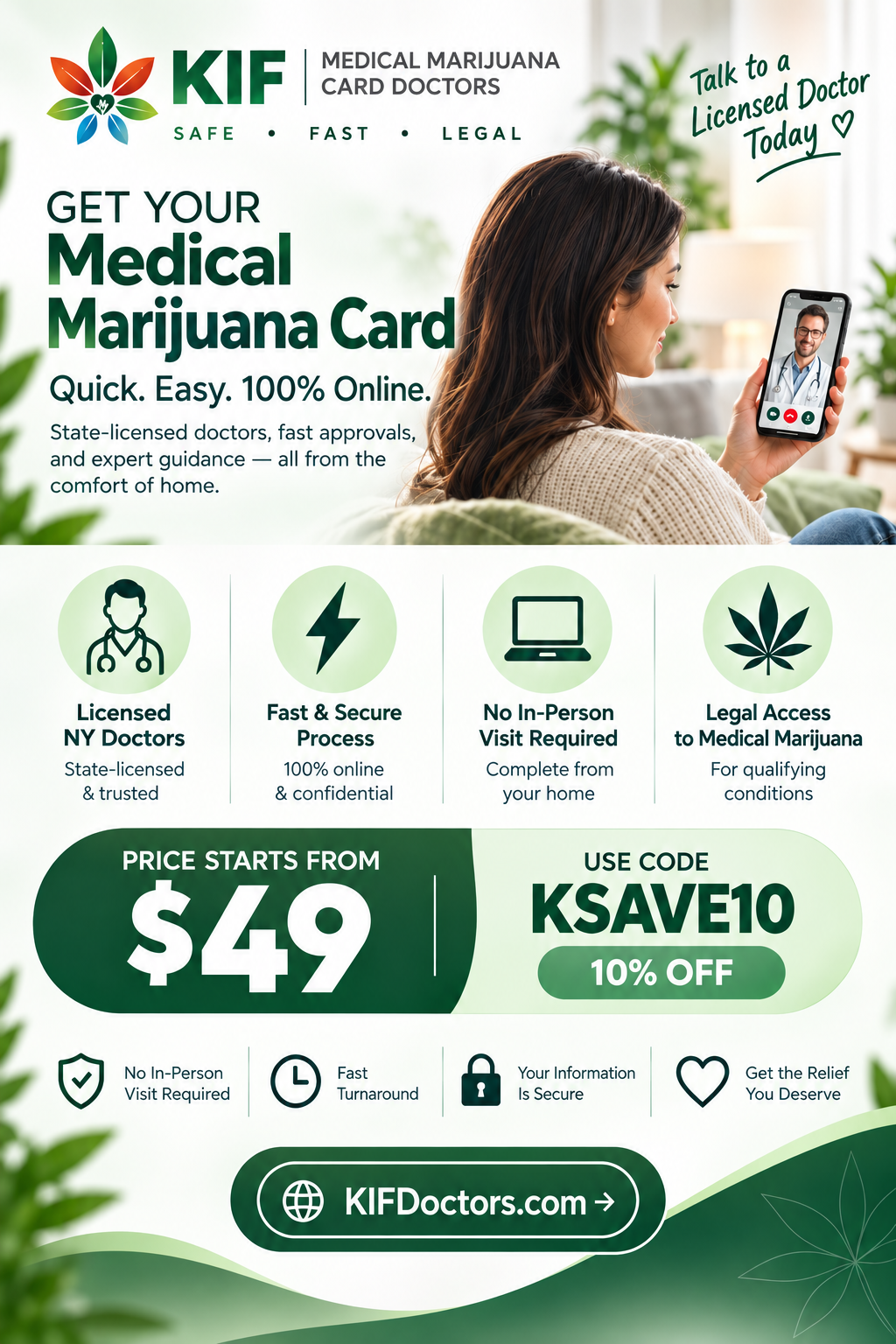
One telehealth option worth knowing about is Kif Doctors, which offers same-day medical marijuana certifications online. If you want to Get Medical Marijuana Card Online Instantly, their process is designed to be fast, straightforward, and accessible from anywhere in New York State, including Ithaca.
Pro tip: When booking an appointment, confirm that the provider is registered with the OCM and ask whether they have experience with your specific condition. A provider familiar with your condition will be better equipped to recommend the right cannabis products and dosing strategies.
Step 4: Attend Your Medical Evaluation
Whether you choose an in-person visit or a telehealth appointment, the evaluation itself is a medical consultation, not a test you can pass or fail. The provider will review your health history, discuss your symptoms, ask about previous treatments, and determine whether medical cannabis is appropriate for your situation.
During the consultation, be honest and thorough. Describe your symptoms clearly, mention what treatments you have already tried, and explain how your condition affects your daily life. The more context you provide, the more personalized your certification and product recommendations will be.
If the provider determines you are a good candidate, they will issue you a certification. In New York, this certification is submitted electronically to the state system, so you do not receive a physical card from the provider. Instead, you will use the state’s online registry to complete the next step.
Common mistake to avoid: Do not assume that receiving a certification means you are immediately registered. You still need to complete your registration with the New York State Medical Cannabis Program before you can purchase from a dispensary.
Step 5: Register with the New York State Medical Cannabis Program
Once your healthcare provider submits your certification, you need to register yourself in the New York State Medical Cannabis Program patient registry. Here is how to do it:
- Visit the New York State Office of Cannabis Management website at cannabis.ny.gov.
- Navigate to the medical cannabis patient registration section.
- Create an account using the email address you provided to your certifying provider.
- Enter your personal information and confirm your certification details.
- Pay the registration fee if applicable. New York has worked to reduce barriers, and fee waivers may be available for patients receiving Medicaid or other qualifying assistance programs.
- Download or screenshot your registry ID number, which serves as your medical cannabis card.
Your registry ID can be stored on your phone or printed out. You will present this along with your government-issued ID when visiting a dispensary. New York does not issue a physical card in the traditional sense — your registry number is your proof of enrollment.
Step 6: Visit a Medical Cannabis Dispensary in or Near Ithaca
Ithaca and the surrounding Tompkins County area have seen growth in cannabis retail access since New York’s cannabis market began expanding. When visiting a dispensary for the first time, bring your registry ID number and your government-issued photo ID.
Dispensary staff, often called patient care specialists or budtenders, are trained to help you navigate product options. Do not hesitate to ask questions about the difference between indica and sativa strains, tinctures versus capsules, or the appropriate ratio of THC to CBD for your condition. A good dispensary will treat your visit as a healthcare interaction, not just a retail transaction.
Pro tip: Start with a low dose, especially if you are new to cannabis as medicine. The principle of “start low, go slow” is widely recommended by cannabis clinicians and helps you find the most effective dose without unwanted side effects.
Step 7: Maintain Your Certification and Stay Informed
Medical cannabis certifications in New York are not permanent. They must be renewed, typically on an annual basis, depending on what your certifying provider specifies. Mark your renewal date on your calendar well in advance so your access is never interrupted.
Also stay informed about changes to New York’s cannabis regulations. The OCM regularly updates rules around products, possession limits, and patient rights. Keeping up with these changes ensures you are always operating within the law and taking full advantage of the protections the program offers.
Frequently Asked Questions About Getting a Medical Marijuana Card in Ithaca, NY
Can I use a telehealth appointment to get certified in Ithaca?
Yes. New York State allows telehealth consultations for medical cannabis certifications. This is a particularly convenient option for Ithaca residents who may not have easy access to a local registered provider or who prefer to complete the process from home.
How long does it take to get my medical marijuana card in Ithaca?
The process can be completed in as little as one day if you use a same-day telehealth service and register promptly with the state system. In-person appointments may take longer depending on provider availability in the Ithaca area.
Are there dispensaries in Ithaca, NY?
Yes, Ithaca and the broader Tompkins County region have cannabis retail locations. As New York continues to license new dispensaries, availability in the area is expected to grow. It is worth checking the OCM’s dispensary locator on their official website for the most current and up-to-date locations near you.
How much does it cost to get a medical marijuana card in New York?
Costs vary depending on the provider you choose for your evaluation and whether you qualify for a state registration fee waiver. Telehealth consultations typically range from $75 to $200. The state registration fee has been structured to be minimal, and Medicaid recipients may qualify for a waiver.
What conditions qualify for a medical marijuana card in Ithaca, NY?
New York gives registered practitioners broad discretion to certify any condition they believe would benefit from medical cannabis treatment. Common qualifying conditions include chronic pain, anxiety, PTSD, cancer, epilepsy, multiple sclerosis, and Crohn’s disease, among many others.
Can I grow my own marijuana with a medical card in New York?
As of the current regulations, adult-use home cultivation has been addressed in New York’s cannabis laws, but the rules for medical patients specifically can differ. Check the latest guidelines from the New York State Office of Cannabis Management for the most accurate information on home cultivation rights.
Does having a medical card protect me from legal issues in Ithaca?
Yes. Being a registered patient in the New York State Medical Cannabis Program provides legal protections for purchasing and possessing medical cannabis within the limits set by the state. Always carry your registry ID and stay within the legal possession limits.
Can out-of-state patients use their medical marijuana card in Ithaca?
New York does not currently have a formal reciprocity program for out-of-state medical cannabis cards. Visitors from other states with valid cards may not be able to purchase from New York dispensaries as medical patients. However, adult-use cannabis is legal in New York for those 21 and older, which may apply in some situations.
What products can I buy with a medical marijuana card in New York?
Medical cannabis patients in New York have access to a wide range of products including flower, oils, tinctures, capsules, edibles, vaporizer cartridges, and topicals. The specific products available depend on the dispensary you visit and current state regulations on product types.
Is my medical marijuana information kept private in New York?
Yes. New York State law protects the confidentiality of medical cannabis patient records. Your information is not shared with employers or law enforcement as part of routine registry operations. Your certification and registration are treated with the same privacy standards as other medical records.
Conclusion
Getting a medical marijuana card in Ithaca, NY, is a manageable process when you know what to expect at each stage. From confirming your eligibility and gathering your documents to completing your evaluation and registering with the state, each step builds on the last. Ithaca’s community is well-positioned to support patients exploring this option, and with telehealth services expanding access statewide, geography is no longer a barrier. Take the first step by scheduling your evaluation, and give yourself the opportunity to explore a treatment path that is working for many New Yorkers living with chronic and complex health conditions.
Official sources and references:
- New York State Office of Cannabis Management – cannabis.ny.gov
- New York State Department of Health – Medical Marijuana Program